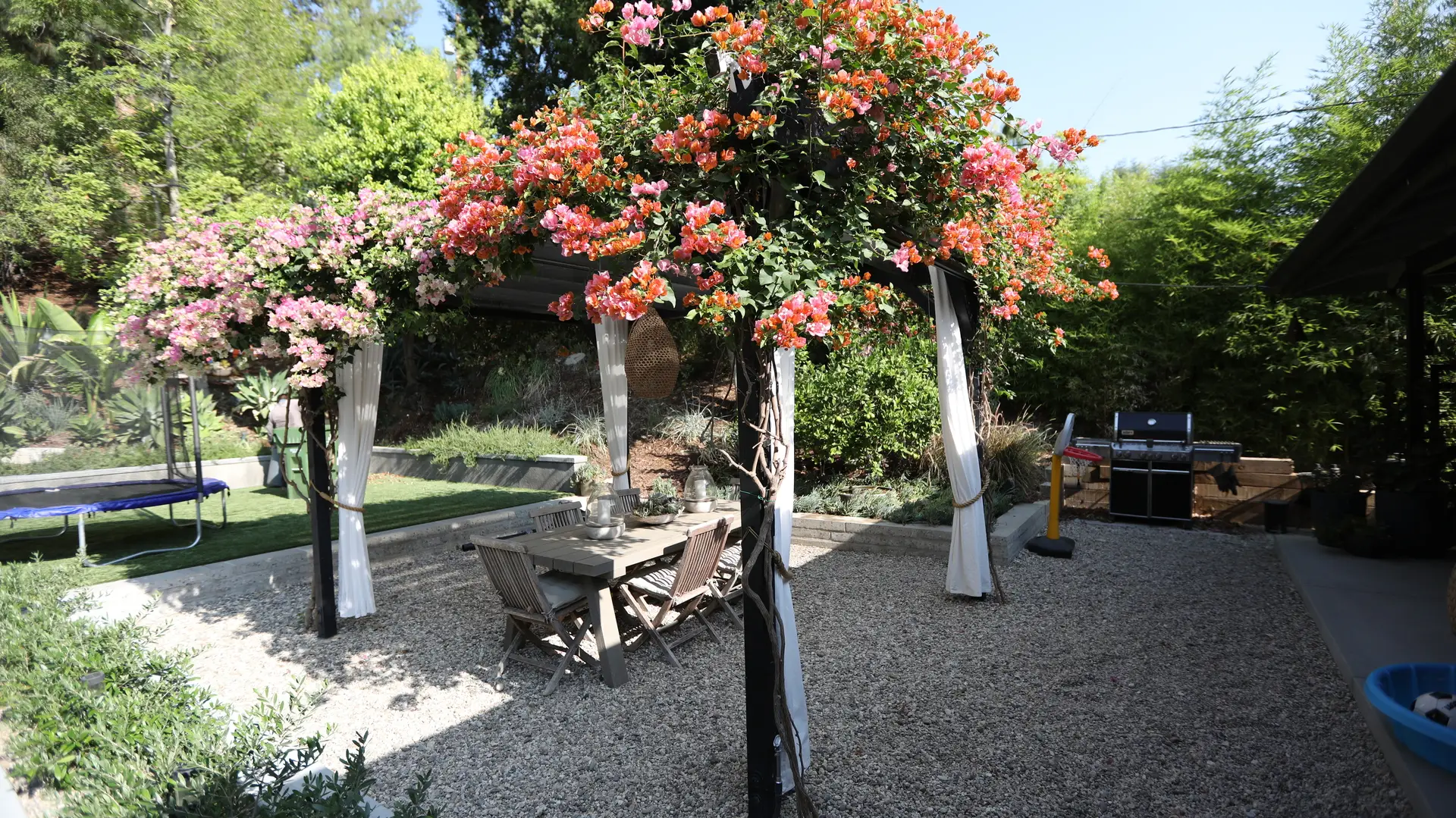
There is a quiet irony in the Los Angeles outdoor living conversation. Homeowners invest significantly in custom architecture, premium hardscaping, and luxury outdoor furniture—and then spend the peak of summer retreating indoors behind central air.
July in Los Angeles is not gentle. Depending on your microclimate—whether you are facing the unbuffered heat of the Valley or navigating the intense midday sun after the Venice marine layer burns off—temperatures regularly push into the mid-90s. Without proper planning, a beautifully designed patio becomes a decorative, unusable slab by 11:00 AM.
The fix is not attempting to air condition your backyard. It is designing with the realities of July in mind from the outset. A garden engineered for high summer relies on a precise mix of solar orientation, thermal mass, material selection, and airflow corridors. When these elements work together, your outdoor space becomes the most comfortable room in the estate during the warmest months of the year.
This guide walks through the practical steps to transform a standard Los Angeles garden into a space that genuinely performs in the July heat, rather than one that sits empty from June through September.
Step 1: Map the True Thermal Load
Every downstream design decision depends on understanding exactly where the sun hits your property, and when. In July, the sun tracks a high, relentless arc across the sky, hitting western exposures with a brutal late-afternoon beating that properties simply do not receive during the cooler months.
Before breaking ground, we map the shade patterns at three critical points: 9:00 AM, 1:00 PM, and 5:00 PM. The zones facing direct sun during the 11:00 AM to 3:00 PM window represent peak thermal load. These areas must be either aggressively shaded by architecture, protected by mature canopy trees, or designated as low-traffic zones. Do not design around morning comfort—design for afternoon survival.
Step 2: Build Structural Shade for Immediate Usability
Planted shade is a long game. A California Pepper tree or a mature Jacaranda provides extraordinary canopy, but if you are starting with a bare garden, you are years away from meaningful coverage. For immediate July usability, structural shade must carry the load.
Motorized aluminum louvered pergolas are among the most effective investments in luxury outdoor design. They allow you to modulate light across the entire arc of the day—open in the morning, partially closed at noon, completely sealed during the 2:00 PM heat peak, and angled open again at sunset to catch the breeze.
Step 3: Harness the Afternoon Airflow Corridors
In the coastal zones of Los Angeles, the afternoon onshore breeze is a natural cooling asset that most garden designs inadvertently block. In neighborhoods like Marina Del Rey, Santa Monica, and the South Bay, that southwest breeze consistently arrives between 1:00 PM and 6:00 PM, dropping the perceived temperature by eight to twelve degrees—if it can flow unobstructed.
Solid masonry walls and dense, overgrown shrub borders act as dams, trapping stagnant heat. A July-ready design respects prevailing wind directions, utilizing open-panel architectural fencing, slatted timber screens, and strategically gapped planting rows to maintain privacy while letting the breeze circulate freely.
Step 4: Rethink Hardscape Material Interlocking
Standard grey concrete is one of the worst performers in July. It absorbs and re-radiates heat with remarkable efficiency, turning a modern pool deck into a literal griddle by mid-afternoon.
To manage heat, we pivot to lighter-colored, highly reflective materials with high solar reflectance values. Tumbled travertine, white limestone, and pale sandstone absorb significantly less heat and radiate it back at a much lower intensity. Honed finishes are preferred over polished ones around pool surrounds; they remain remarkably cool underfoot and provide essential non-slip safety when wet.
Step 5: Select Botanicals That Peak in the Heat
A high-summer garden should look lush and intentional, not scorched. This requires bypassing high-water-demand plants in prominent focal zones. Hydrangeas and traditional roses may look spectacular in spring, but they communicate visual struggle by late summer.
Instead, we lean into architectural Mediterranean and California native flora that explicitly peak during the warmest months:
- Structural Focal Points: Mass plantings of Agave attenuata set against smooth plaster walls.
- Texture & Contrast: Underplantings of golden Festuca paired with the striking geometric spikes of Hesperaloe.
- Color & Movement: Deep purples and crisp whites from drought-resilient Salvias and Lavender that thrive under intense solar pressure.
Step 6: Layer in Strategic Evaporative Cooling
While a water feature won’t single-handedly alter a microclimate, it introduces powerful sensory and evaporative cooling. A custom rill, architectural cascade, or minimalist fountain placed directly upwind of a primary lounge zone creates a microclimatic shift. As the afternoon breeze moves across the moving water, it delivers water vapor directly across the seating area, lowering the perceived temperature and transforming the space into a true sensory sanctuary.
Designing a garden that thrives in the height of a Los Angeles summer is a matter of precision engineering, not stylistic compromise. The result is an outdoor estate that comfortably earns its square footage every single day of the year.